


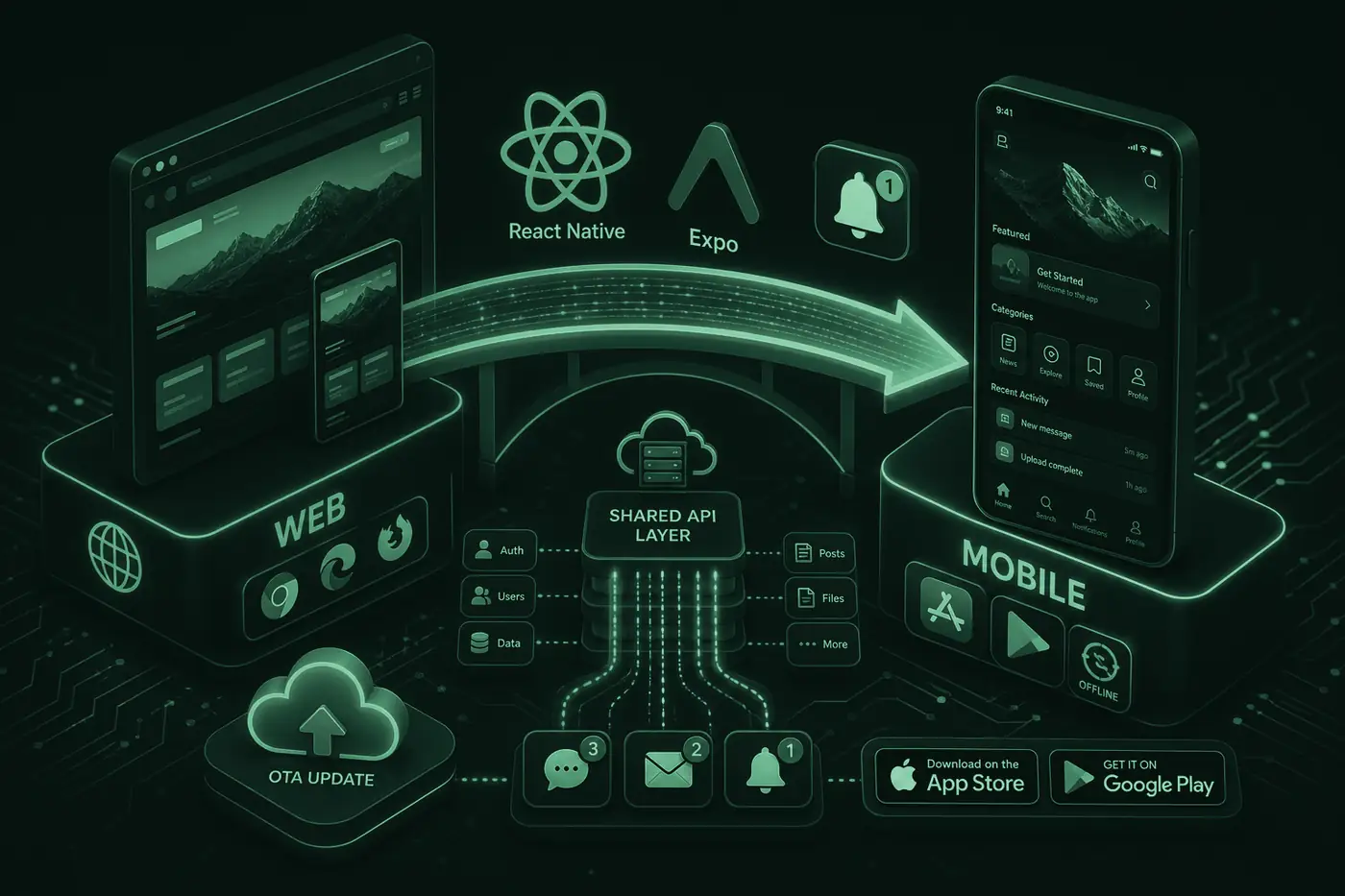

If your website drives traffic, converts visitors and represents your brand well, the next logical step may be a mobile app. Responsive design delivers a site that works on phones; a native app adds push notifications, offline access and a home-screen presence. This article covers the business benefits of moving a successful web project to mobile and how to do it with React Native and Expo.
Isn't Responsive Web Enough?
Responsive design delivers a good experience in mobile browsers and is enough for most corporate sites at the start. As the business grows, user expectations change:
| Feature | Responsive web | Native mobile app |
|---|---|---|
| Access | Via URL in browser | Home screen icon; opens with one tap |
| Push notifications | Limited (partially with PWA) | Full support; campaigns and order alerts |
| Offline use | Requires internet | Limited offline access via cache |
| Camera / location | Longer permission flow | Native API access; QR, maps, photos |
| Performance | Depends on browser layer | Smoother animations and transitions |
| Brand loyalty | Visitor model | Daily active user (DAU) potential |
| App Store visibility | None | Discoverability on App Store and Google Play |
The customer walks by and looks at the window; they see products but must find the way each time. A visitor model.
Site opened in browserA card in the customer's pocket; opens with one tap, reminded by notifications, builds repeat-visit habits.
App icon on home screenBusiness Advantages
- Customer loyalty: A home-screen app increases return visits; push notifications are a direct channel for campaigns and order tracking.
- Higher conversion: Registered users, one-tap payment and saved addresses shorten checkout.
- Brand prestige: Presence on the App Store and Google Play strengthens corporate trust.
- Data and analytics: In-app behavior, session length and funnel analysis offer richer data than web analytics alone.
- Competitive edge: An app differentiates you when competitors rely on web only.
- Shared backend: Your existing Node.js and Prisma API serves both web and mobile clients; the data layer is not rewritten.
What Are React Native and Expo?
React Native is Meta's cross-platform mobile framework. Teams with React experience build iOS and Android apps with the same component model; no separate native teams and budgets.
Expo is a development platform built on React Native. It simplifies builds, store publishing, push notifications, camera and location; OTA (over-the-air) updates let you ship small fixes without waiting for store approval.
Why React Native + Expo?
Single codebase
One TypeScript project instead of separate Swift/Kotlin teams for iOS and Android. Lower maintenance cost and faster delivery.
Code sharing with web
Business logic, type definitions and API clients can live in shared modules with your Next.js project.
Fast publishing with Expo
EAS Build for automatic App Store and Google Play builds; EAS Submit simplifies store submission.
NativeWind / Tailwind
Tailwind CSS habits from the web project carry over to mobile UI with NativeWind; consistent design language.
When to Move to Mobile
- Repeat usage: If users log in more than once a week (e-commerce, appointments, membership), an app makes sense.
- Push notification need: Order status, campaigns or appointment reminders are critical; native app is required.
- 50%+ mobile web traffic: You already have a mobile audience; an app converts part of it into loyal users.
- Offline or field use: Warehouse, field sales or event apps benefit from offline access.
- May be too early: Single-page brochure, rarely visited corporate site or MVP stage — strengthen responsive web first.
Transition Process: Step by Step
- Analyze current web Identify top pages, conversion points and mobile traffic share.
- Define MVP scope Pick critical flows instead of copying the whole site: login, catalog, cart, profile.
- API layer Extend the existing REST API or add mobile endpoints to your Node.js + Prisma backend.
- React Native development iOS and Android UI with Expo; auth, push and payment integrations.
- Test and store launch Real device testing, App Store / Google Play review and soft launch.
- Coexist with web The app does not replace web; both serve different usage scenarios.
Alternatives: Flutter and PWA
- Flutter: Google's cross-platform framework; Dart language, strong performance. Alternative when away from the React ecosystem.
- PWA (Progressive Web App): "Add to home screen" for the website; push and offline partially possible. Lower cost, not as powerful as full native.
- Separate native (Swift + Kotlin): Maximum platform customization; requires two teams and higher budget.
Practical tip
If your web project is built with Next.js and TypeScript, React Native + Expo offers the lowest-friction transition. Most of your API, types and business rules can be reused; you do not start from zero.
Common Mistakes
- Copying the website one-to-one on mobile; mobile UX is different — simplify.
- Writing a separate backend for mobile; extending the existing API is enough.
- Launching without a push notification strategy; notification spam drives users away.
- Ignoring App Store optimization (ASO); discoverability stays low.
- Abandoning web and relying on the app only; SEO and organic traffic come from web.
- Setting deadlines without planning store review; Apple/Google approval can take 1–2 weeks.
Professional Mobile App Building
A well-planned web-to-mobile transition preserves your existing investment and opens a new growth channel. At Veltstack we build iOS and Android apps from a single codebase with React Native, Expo, TypeScript and your existing Node.js backend; we handle store publishing and push notification integration end to end.
Conclusion
Moving a successful web project to a mobile app increases customer loyalty, conversion and brand prestige. With React Native and Expo the transition is both fast and sustainable; your existing backend and React knowledge are a major advantage. If your web traffic is growing and usage is repeat-heavy, we strongly recommend evaluating a mobile app.