


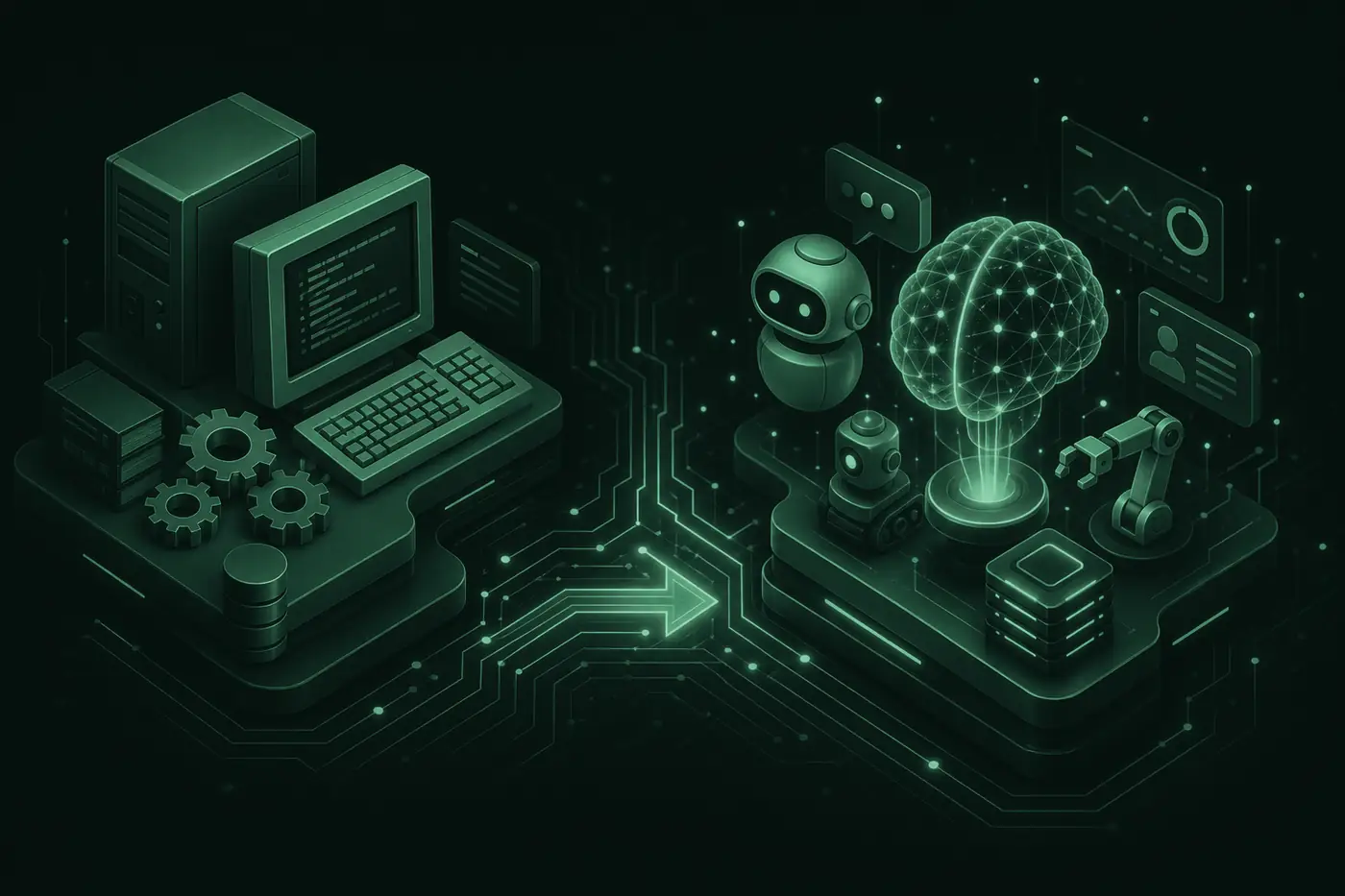

Once you choose custom software, the next question is: will the project be built by human developers or by AI tools alone? Our clear view: for quality software, a human must write the code. AI is only a helper; architecture, code review and accountability stay with people. This guide explains why traditional software development remains essential, the limits of AI and the right balance.
Why a Human Developer?
Traditional software development means an engineer who understands business rules, designs architecture, writes code and tests it is actively involved. AI output may look fast, but context, accountability and quality guarantees cannot exist without human expertise.
- Business logic: Only an experienced developer interprets customer needs, edge cases and long-term impact correctly.
- Architecture ownership: Database schema, security layers and performance decisions must be made by humans.
- Code ownership: Maintenance, debugging and evolution belong to a team, at least one person.
- Security and compliance: GDPR, payments and access control are areas AI alone cannot guarantee.
- Quality bar: In professional projects, code must not go live without human review.
What Is AI and Why It Is Not Enough Alone
AI is a powerful helper for code suggestions, text generation, automation and faster research. But AI can hallucinate, suggest outdated APIs, produce insecure code and lacks your project's business context. "AI wrote it, we shipped it" is unacceptable on serious projects.
Like a skilled intern: fast drafts and ideas; final decisions and signature stay with the master.
Cursor & ClaudeLike an architect and engineer: designs the system, writes code, reviews, tests and ships.
DeveloperComparison: Traditional Software Always Wins
| Feature | AI Alone | Human + Traditional Process |
|---|---|---|
| Code quality | Inconsistent, out of context | Standards-compliant, reviewed |
| Security | High hidden vulnerability risk | Controlled via review and tests |
| Business logic | Shallow understanding | Deep domain knowledge |
| Maintenance | Unclear ownership | Clear ownership and docs |
| Performance | May stay unoptimized | Profiling, measurement, tuning |
| Professional projects | Insufficient | Essential |
Using AI Correctly
We do not reject AI, we place it correctly. It saves time on boilerplate, regex, documentation drafts and repetitive CRUD. But every AI output must be read, tested and approved by a human developer. Code review is not optional; it is mandatory.
Our clear recommendation
"Let AI build the project and we only deploy" does not work in professional software. A human must write, review and own the code; AI speeds up that process as a helper.
Development Process
Common Mistakes
- Shipping AI output to production without reading it
- Treating code review as a waste of time
- Trying to build custom software projects with prompts alone
- Leaving security testing to AI
- Assuming inexperienced team + AI equals expertise
Connection to Custom Software and Stack
Code written by humans makes sense inside a custom software architecture. On projects built with Next.js, TypeScript and Prisma, AI is only a tool under developer control. See our React & Next.js guide for the modern stack.
Our Approach at Veltstack
At Veltstack we write the code ourselves on every project. We use AI for research, drafts and repetitive tasks; architecture, security, performance and final code quality remain fully human responsibilities. Every commit is reviewed; every production release is a deliberate sign-off.
Conclusion
AI makes development easier; but for quality, secure and sustainable software, a human must write the code. Traditional discipline, analysis, design, code, review, test, is non-negotiable for professional projects. Contact us to bring your project to this standard.